
Interview 1
Christy Morgan
Manager of Reconciliation Strategy · TELUS · May 21, 2026
Note: the beginning of the audio clip had a glitch, so it is unavailable. Apologies for the abrupt start.
Length: 17:09
Aboriginal Studies 30 · Capstone Project
"To what extent are reconciliation efforts in Treaty 7 territory positively affecting Indigenous self-determination and education?"
This website exists with the goal of educating on how reconciliation is being practiced in Calgary and Treaty 7 territory today, especially whether or not these efforts are actually improving relationships between Indigenous and non-Indigenous peoples. It is also extremely important to know how Indigenous people in Alberta personally experience reconciliation, which leads to how the Calls to Action 43 and 57 are being applied in real life. Learning about how the Tsuu T'ina Nation preserves culture and identity as well as how Indigenous self determination is linked to reconciliation is also an aspect that will be explored through this site. Countries such as New Zealand and their reconciliation efforts will serve as comparisons to Canada's own efforts as well. Many of these questions will be answered in the audio interview done with the Manager of Reconciliation Strategy at TELUS, with the company serving as a real life example on how companies can integrate Indigenous reconciliation efforts in their strategies. These subjects will aid in the conclusion of whether or not Canada's reconciliation efforts have been successful in Indigenous people's perspective.
01 — Voices
This conversation involved the discussion of how TELUS, a large telecom company, is involved in voluntary cultural learning, reconciliation and Indigenous self-determination efforts across Treaty 7 territory in Alberta.
Interview 1
Manager of Reconciliation Strategy · TELUS · May 21, 2026
Note: the beginning of the audio clip had a glitch, so it is unavailable. Apologies for the abrupt start.
02 — Land
Below are a view of the land significant to the reconciliation efforts spoken about in the interview and this website.
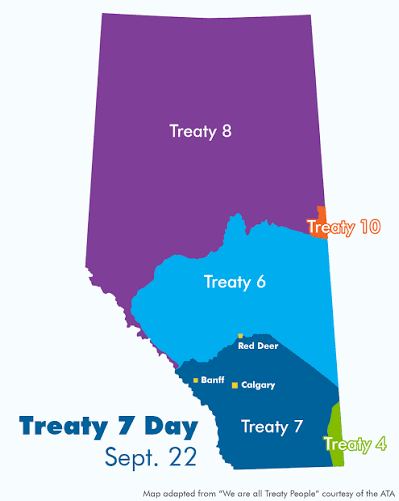
Map of the Treaty 7 area in southern Alberta, as well as Treaty 6 and 8 land.
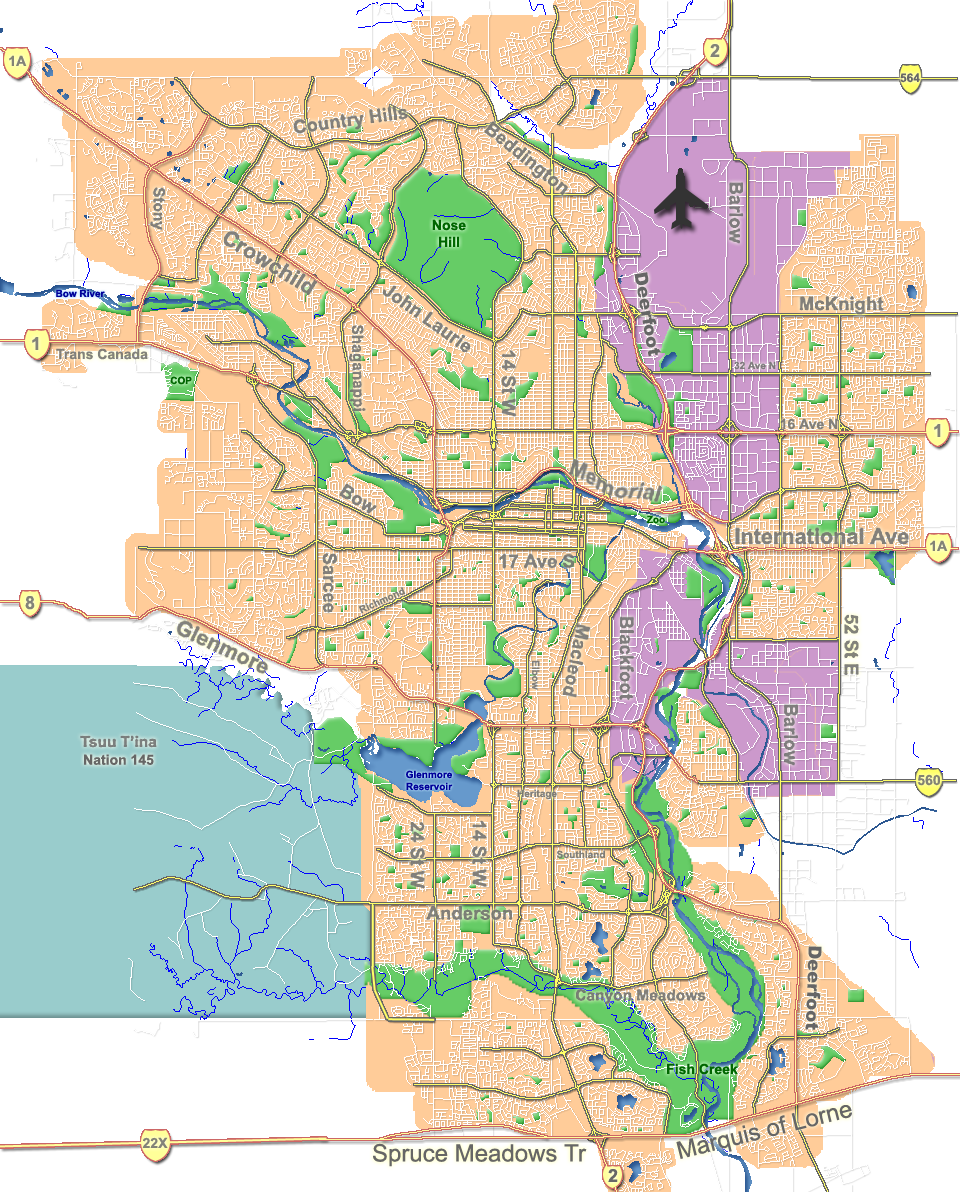
The photo above shows Calgary, Alberta and The Tsuu T'ina Nation 145 reserve, located directly West of the city.
03 — Policy
Out of all of the Calls to Action, the website focuses on these two, as they are the two that are among the most connected to Indigenous self-determination and education. In total, these two Calls to Action can create a country whose inhabitants are more educated, as well as ensuring that Indigenous people have their rights to make decisions that affect their communities.
Call to Action
"We call upon federal, provincial, territorial, and municipal governments to fully adopt and implement the United Nations Declaration on the Rights of Indigenous Peoples as the framework for reconciliation." (Government of Canada) This call to action ensures that Indigenous rights and interests are being protected when laws and decisions are made. The benefit of this is that it strongly encourages Indigenous self-determination, advancing reconciliation. This relates to the Treaty 7 territory communities, as it promotes Indigenous participation where their communities are directly affected.
Call to Action
"We call upon federal, provincial, territorial, and municipal governments to provide education to public servants on the history of Aboriginal peoples, including the history and legacy of residential schools, the United Nations Declaration on the Rights of Indigenous Peoples, Treaties and Aboriginal rights, Indigenous law, and Aboriginal-Crown relations. This will require skills-based training in intercultural competency, conflict resolution, human rights, and anti-racism" (Government of Canada). This Call to Action calls on the government to educate their public servants about Indigenous peoples and history. This is crucial towards reconciliation, as it helps in keeping public servants informed, ensuring they make culturally respectful decisions. Increased education and knowledge within the population can lead to policies that promote Indigenous self determination and community needs, while also reducing stereotypes and racism.
04 — Words
These quotes are some of the most impactful from the interview, as they encapsulate the purpose of this project, being education, self determination and reconciliation. They are all in reference to the Calls to Action 43 and 57 and together, the interview reveals that reconciliation is more than mere gestures. Meaningful actions such as becoming educated and respecting Indigenous self determination are crucial in true reconciliation.
"People are actually taking ownership of their own learning, their ownership of their own actions."
— Christy Morgan
Manager of Reconciliation Strategy · TELUS
"That's that's what it's all about is self-determination, right? It is about reclaiming what's been taken away from us in the last...500 years under policy."
— Christy Morgan
Manager of Reconciliation Strategy · TELUS
"We don't ever push on our community to do something... If you choose to take advantage of any of these and want to work with us, then please let us know."
— Christy Morgan
Manager of Reconciliation Strategy · TELUS
05 — Comparison
In order to see how effective reconciliation in Treaty 7 territory, Canada's progress must be benchmarked against an international standard that has had relative success in relations between Indigenous people and the state. Below is a table that compares the two states through multiple facets.
| Dimension | Canada | New Zealand |
|---|---|---|
| Founding treaty / document | Numbered Treaties (1871–1921) | Treaty of Waitangi (1840) |
| Formal apology | In 2008, Canada delivered a single federal apology for the trauma and cultural destruction caused by residential schools. This drove many of the current day educational calls to action. | New Zealand integrates legally binding apologies into ongoing legislative treaty settlements for breaches of the Treaty of Waitangi in the past. |
| Land settlements | Often very slow in Canada, as they are often stalled by complex federal and provincial disputes over territory. | New Zealand unitizes Waitangi Tribunal to settle Crown breaches. This results in legally binding returns of ancestral land directly to tribes. |
| Language revitalization | Canada enacted the Indigenous Languages Act in 2019. However, the implantation of this act is still decentralized and very reliant on localized and community funding. | New Zealand granted Granted Māori status as an official language of the country in 1987. This has imbedded Indigenous language in country; in their public broadcasting, government and immersion schools. |
| Representation in government | Canada still relies on conventional democratic pathways, meaning that there are inconsistent levels of Indigenous political representation. There are also no guaranteed seats in Parliament for Indigenous representation. | New Zealand has a legislative system of Māori Seats that was established in 1867 that guarantees a mandatory base amount of Indigenous representation in Parliament. |
06 — Findings
While there has been meaningful progress and change within the Treaty 7 territory, many of Canada's efforts are incomplete. This is especially apparent when compared to countries such as New Zealand, who have legally embedded, national frameworks in place. The primary research of the interview proved that within Treaty 7 territory, meaningful change is happening on the ground with companies such as TELUS. Their efforts such as shifting the responsibility of Indigenous education off of Indigenous individuals is proof that allies are finally taking active ownership of work. In Canada, there has been real success with Call to Action 57, with local and voluntary initiatives such as retail stores integrating Knowledge Keepers and digital learning. However, Canada has its limitations exposed when talking about how Indigenous communities can achieve true self determination under Call to Action 43. In comparison to New Zealand, with their guaranteed Māori parliamentary seats, Canada does not have the adequate structure. Reconciliation in Treaty 7 has been successful in making shifts within its communities. However, it cannot be considered a full, systemic change until Canada bridges the gap between corporate progress and legislative frameworks.
07 — References
The books, articles, interviews, websites, and other materials used in this project.